OccuPros Safety Academy | Online Theory
Compressed Gas Cylinder Safety
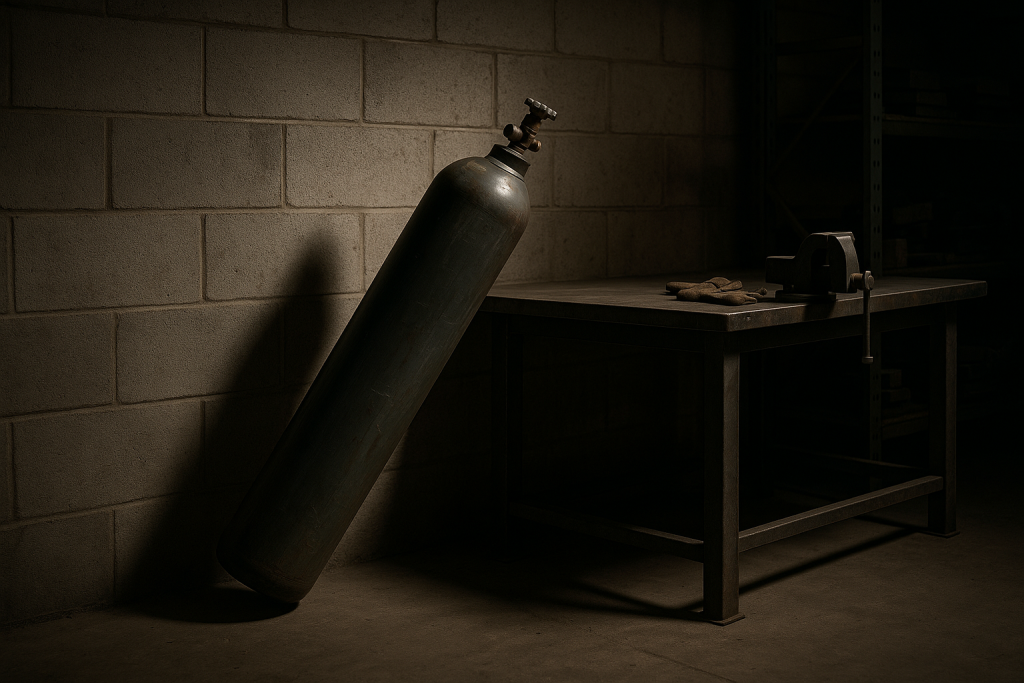
That steel bottle in the corner does not look like much. Inside it is enough stored energy to punch through a cinder-block wall. This course teaches you to respect that energy, control it, and keep everyone around it safe.
A compressed gas cylinder is one of the most ordinary-looking dangerous things on a worksite. It stands quietly in the corner of a welding bay, a fabrication shop, a lab, a hospital storeroom, the back of a service truck. It does not hum, spark, or move. So we lean tools against it, leave it standing free on the floor, drag it by the cap, and forget it is there. That calm is deceptive. A standard cylinder holds gas at thousands of pounds per square inch, and that pressure is not just sitting there. It is a coiled spring waiting for a way out, and if the valve ever snaps off, the cylinder finds one instantly.
When a charged cylinder loses its valve, it becomes an uncontrolled rocket. The escaping gas drives the steel bottle across a room, through racks and walls and anything else in its path, with enough force to kill. This is not a rare freak event. It has happened in shops and on docks because a cylinder tipped over, got knocked, or was handled without its protective cap. The whole point of this course is that none of it is mysterious or hard to prevent. Cylinder safety comes down to a short list of disciplined habits: cap it, secure it upright, separate the gases that should never mix, keep oil and heat away, move it the right way, and check it before you trust it. Learn those, make them automatic, and the rocket in the corner stays exactly what it should be, a tool that goes home with everyone at the end of the day.
What you will learn
- Why a compressed gas cylinder stores enormous energy, and how a knocked-off valve can turn it into a missile that flies through walls.
- What OSHA 1910.101 to 1910.105 and 1926.350 require, and how CGA good practice fills in the how-to: valve caps on, cylinders secured upright, and safe handling.
- How to store and separate gases correctly: oxidizers like oxygen kept 20 feet from fuel gases like acetylene, or behind a fire-rated barrier, and away from heat, sparks, and oil.
- Why acetylene must stay upright and never exceed 15 psig, why oil and grease near oxygen can explode, and how regulators and flashback arrestors protect you.
- How to move cylinders with a cart, leak-check with soapy water, open valves slowly, inspect for damage, mark empties, and build a daily cylinder walkthrough.
Who this is for
Awareness and information training aligned with OSHA 29 CFR 1910.101 to 1910.105 (Compressed Gases) and 1926.350 (Gas Welding and Cutting), and referencing Compressed Gas Association (CGA) good practice. Online awareness and information training that supports your employer’s required hazard-specific and site-specific training and is not a substitute for it. OccuPros | (469) 746-4040 | occupros.com | Every Worker Home Safe.
Course References
- OSHA standards and guidance applicable to Compressed Gas Cylinder Safety
- Employer written safety procedures and site-specific plans
- Manufacturer instructions, SDSs, permits, inspection forms, and emergency action plans when applicable
Applicable Industries:
OccuPros Safety Instructor Team
Every OccuPros course is developed and reviewed by our team of Certified Safety Professionals (CSP) and Safety Management Specialists (SMS) with 15+ years of field experience across construction, oil & gas, manufacturing, and general industry. Our instructors don't just teach safety - they've managed safety programs on active jobsites, conducted OSHA compliance audits, and published 184 safety course topics nationwide.
Before you buy
The practical questions, answered plainly.
Do I get a certificate?
Yes. When you finish the course and pass the assessment, your certificate of completion is available to download immediately from your dashboard. It carries a verification number.
How long do I have access?
Access to this course does not expire. It is self-paced, so you can start, stop and resume whenever you like, and your progress is saved between sessions.
What if I fail the assessment?
You can retake it. Knowledge checks run through the course and the final assessment draws from a larger question bank, so a retake will not simply repeat the same questions.
Does this replace hands-on training?
This course delivers the knowledge portion. Site-specific procedures, equipment-specific practice and any required practical evaluation remain your employer's responsibility, and the course is explicit about where those lines fall.
How often does this training need repeating?
The recommended refresher cadence for this topic is annually. Retraining is also triggered by a change in process or equipment, or by an observed gap in an employee's knowledge.
Can I buy this for my whole crew?
Yes. Choose "My team" on this page to buy seats instead of a single enrolment. You become the team administrator, assign seats from your Team Portal as people join, and volume pricing applies automatically at 5 seats and again at 10.
Frequently Asked Questions
What does the Compressed Gas Cylinder Safety course cover?
It covers safe handling, storage, transport, and use of compressed gas cylinders, including securing cylinders, valve protection, and separating incompatible gases. It also addresses recognizing leaks and responding to cylinder hazards. The content aligns with general OSHA requirements in 29 CFR 1910 and 1926 for compressed gases.
Who should take compressed gas cylinder training?
It is useful for welders, laboratory and industrial workers, warehouse staff, and anyone who moves, stores, or uses compressed gas cylinders. Supervisors overseeing storage areas also benefit. It provides hazard awareness and safe-handling practices for everyday cylinder use.
Is a certificate included when I finish?
Yes. You can download a digital Certificate of Completion as soon as you complete the course. It serves as a record of training for your files or your employer.
Can I buy this for multiple employees?
Yes. Group and team seats are available so you can enroll and track several workers under one account. Contact us through the site for team pricing.