OccuPros Safety Academy | Online Theory
Shoring, Shielding, and Trench Box Operation
A trench wall can stand all morning and let go in a second, with no warning a person can see. This course teaches you the two systems that keep the wall from burying you, how to tell them apart, and how to work with them so the trench gives you back at the end of the day.
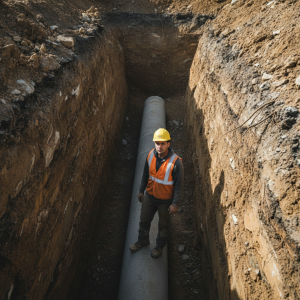
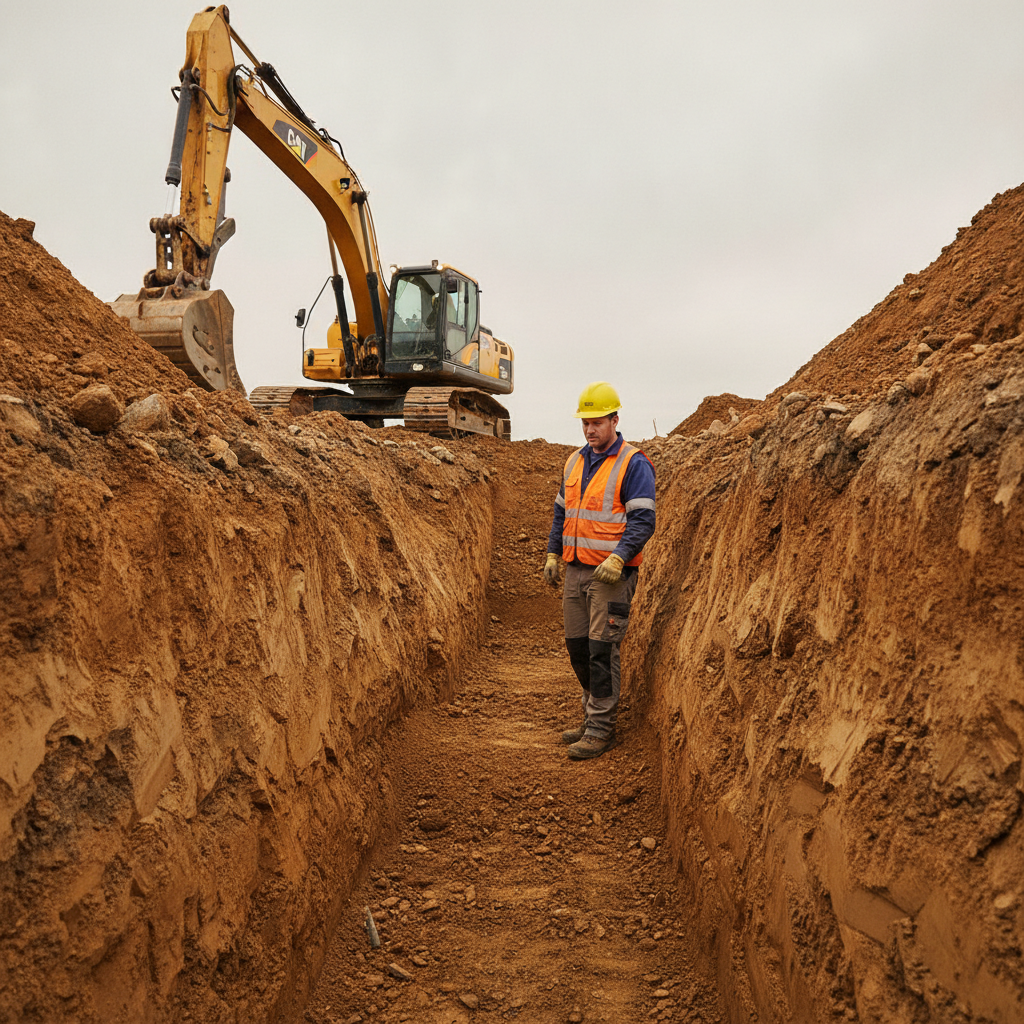
A trench does not look like it is trying to kill you. The walls stand quietly, the bottom is dry, the work is right there, and the soil that was holding the wall ten minutes ago seems just as solid now. That is the trap. A cubic yard of soil weighs around 3,000 pounds, about the weight of a small car, and when a wall fails it comes down faster than a person can step out of the way. There is rarely a warning, rarely time to react, and a worker caught in it is crushed and suffocated in the space of a breath. Trenching and excavation work is among the most lethal jobs in construction for exactly this reason: the hazard is invisible right up until it is fatal.
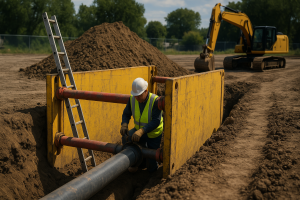
That is what protective systems are for, and this course is about the two families that do the work. Support systems hold the walls back so they cannot move. Protective shields stand between the worker and the wall so that if the wall does move, it cannot reach the person. They sound similar and they are very different jobs, and confusing them gets people killed. This course takes both apart in plain language: what each one actually does, where the limits come from, how to install and remove them from a safe place without ever putting a body in an unprotected trench, and the handful of rules that keep you inside the zone the system is protecting. Aligned with OSHA 29 CFR 1926.652, written for the person standing in the hole.
What you will learn
- The real difference between SUPPORT systems (shoring that holds the walls in place) and PROTECTIVE systems (trench boxes and shields that protect the worker if a wall fails), and why mixing them up is dangerous.
- What OSHA 1926.652 requires: a protective system for nearly every trench 5 feet or deeper, selected and used within its limits.
- How manufacturer tabulated data and registered professional engineer designs set the depth, load, and soil limits you must work inside, and why you never guess past them.
- How to install shoring and shields from the top down and remove them from the bottom up, always from a safe location, never by entering an unprotected trench to place or strip them.
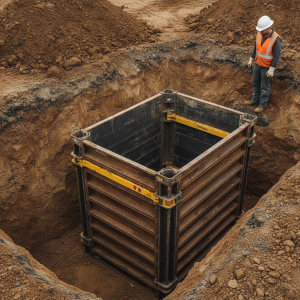
- How to stay inside the protected zone: the box rated for the depth, no stacking beyond rating, a ladder inside the box within 25 feet, spoil and equipment set back, and never working outside the shield.
Who this is for
Aligned with OSHA 29 CFR 1926.652, Requirements for Protective Systems (Subpart P, Excavations). Online awareness and information training that supports your employer’s required site-specific and competent-person training and is not a substitute for it. This course is not a competent-person certification. OccuPros | (469) 746-4040 | occupros.com | Every Worker Home Safe.
Course References
- OSHA standards and guidance applicable to Shoring, Shielding & Trench Box Operation
- Employer written safety procedures and site-specific plans
- Manufacturer instructions, SDSs, permits, inspection forms, and emergency action plans when applicable
Applicable Industries:
OccuPros Safety Instructor Team
Every OccuPros course is developed and reviewed by our team of Certified Safety Professionals (CSP) and Safety Management Specialists (SMS) with 15+ years of field experience across construction, oil & gas, manufacturing, and general industry. Our instructors don't just teach safety - they've managed safety programs on active jobsites, conducted OSHA compliance audits, and published 184 safety course topics nationwide.
Before you buy
The practical questions, answered plainly.
Do I get a certificate?
Yes. When you finish the course and pass the assessment, your certificate of completion is available to download immediately from your dashboard. It carries a verification number.
How long do I have access?
Access to this course does not expire. It is self-paced, so you can start, stop and resume whenever you like, and your progress is saved between sessions.
What if I fail the assessment?
You can retake it. Knowledge checks run through the course and the final assessment draws from a larger question bank, so a retake will not simply repeat the same questions.
Does this course fully certify me?
No, and that matters. This is the online knowledge portion. Full qualification also requires a hands-on practical evaluation conducted by your employer or by OccuPros in person. The course tells you exactly what that evaluation has to cover.
How often does this training need repeating?
The recommended refresher cadence for this topic is annually. Retraining is also triggered by a change in process or equipment, or by an observed gap in an employee's knowledge.
Can I buy this for my whole crew?
Yes. Choose "My team" on this page to buy seats instead of a single enrolment. You become the team administrator, assign seats from your Team Portal as people join, and volume pricing applies automatically at 5 seats and again at 10.
Frequently Asked Questions
What does the Shoring, Shielding & Trench Box Operation course cover?
It covers protective systems for trenches, including shoring, shielding, and the safe installation and removal of trench boxes. You will learn about system selection based on soil and depth, tabulated data, and safe entry and exit. The training is based on general OSHA excavation requirements under 29 CFR 1926 Subpart P.
Who should take this trench protective systems training?
It is designed for excavation crews, equipment operators, and supervisors who install, work inside, or manage protective systems in trenches. It supports workers who need to understand when and how shielding and shoring are used.
Is this course self-paced and mobile-friendly?
Yes. It is a self-paced online course you can start and stop as needed. It runs on phones, tablets, and computers with an internet connection.
Do I get a certificate when I finish?
Yes. A downloadable digital Certificate of Completion is provided as soon as you complete the course, and you can print it or keep it for your records.