OccuPros Safety Academy | Online Theory
Welding Safety (Arc & Oxy-Fuel)
Welding looks like one bright, controlled spark. It is actually five serious hazards happening at once: fire, toxic fumes, blinding radiation, electric shock, and high-pressure gas. This course teaches you to see all five and work them safely.
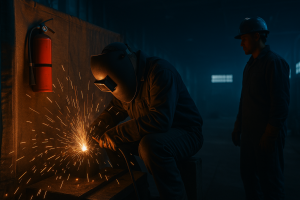
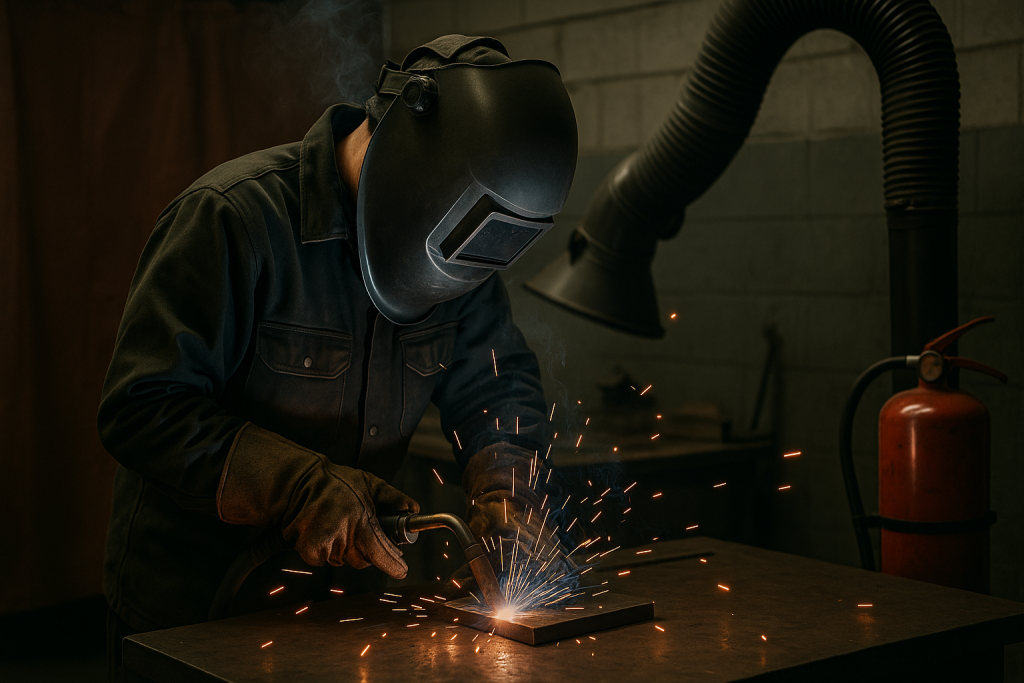
A welder strikes an arc and the work begins. To the eye it is a focused, almost beautiful job: a glowing pool of metal, a shower of sparks, the steady hiss of the torch. That tight focus is exactly what makes welding so easy to underrate. While the welder is concentrating on the bead in front of the helmet, sparks are flying out to thirty-five feet and dropping through floor openings, the fume rising off the metal is loaded with things you do not want in your lungs, the arc is burning the eyes of anyone who glances at it, the electrode is live, and a few feet away two cylinders hold enough stored energy to level a room. None of that announces itself. The arc is bright and the danger is quiet.
Hot work is one of the leading causes of industrial fires, and welders carry some of the highest rates of work-related lung disease and eye injury in the trades. The good news is that every one of these hazards is well understood and well controlled, with permits, fire watches, ventilation, the right shade lens, dry insulated equipment, and cylinders handled with respect. This course takes the five hazards apart one at a time, in plain language, so you can protect yourself and the people working around you and get everyone home.
What you will learn
- The five hazards hiding behind the bright arc: fire, fumes, radiation, electric shock, and compressed gas, and why each one is easy to miss.
- How OSHA regulates welding and cutting, and how a hot work permit and a fire watch actually prevent fires, including the thirty-five-foot rule.
- What is really in welding fume, including manganese and the carcinogen hexavalent chromium, and how ventilation and respiratory protection control it.
- How to read arc radiation and pick the correct shade lens, and how to keep electric shock out of arc welding.
- How to handle oxy-fuel safely: cylinders, regulators, flashback arrestors and check valves, plus compressed gas storage and the full PPE picture.
Who this is for
Aligned with OSHA 29 CFR 1910 Subpart Q (1910.251 to 1910.255) and 29 CFR 1926 Subpart J (Welding and Cutting). Online awareness and information training that supports your employer’s site-specific training and the hands-on qualification required to weld. This course does not by itself qualify you to weld or to issue hot work permits. OccuPros | (469) 746-4040 | occupros.com | Every Worker Home Safe.
Course References
- OSHA standards and guidance applicable to Welding Safety (Arc & Oxy-Fuel)
- Employer written safety procedures and site-specific plans
- Manufacturer instructions, SDSs, permits, inspection forms, and emergency action plans when applicable
Applicable Industries:
OccuPros Safety Instructor Team
Every OccuPros course is developed and reviewed by our team of Certified Safety Professionals (CSP) and Safety Management Specialists (SMS) with 15+ years of field experience across construction, oil & gas, manufacturing, and general industry. Our instructors don't just teach safety - they've managed safety programs on active jobsites, conducted OSHA compliance audits, and published 184 safety course topics nationwide.
Before you buy
The practical questions, answered plainly.
Do I get a certificate?
Yes. When you finish the course and pass the assessment, your certificate of completion is available to download immediately from your dashboard. It carries a verification number.
How long do I have access?
Access to this course does not expire. It is self-paced, so you can start, stop and resume whenever you like, and your progress is saved between sessions.
What if I fail the assessment?
You can retake it. Knowledge checks run through the course and the final assessment draws from a larger question bank, so a retake will not simply repeat the same questions.
Does this replace hands-on training?
This course delivers the knowledge portion. Site-specific procedures, equipment-specific practice and any required practical evaluation remain your employer's responsibility, and the course is explicit about where those lines fall.
How often does this training need repeating?
The recommended refresher cadence for this topic is annually. Retraining is also triggered by a change in process or equipment, or by an observed gap in an employee's knowledge.
Can I buy this for my whole crew?
Yes. Choose "My team" on this page to buy seats instead of a single enrolment. You become the team administrator, assign seats from your Team Portal as people join, and volume pricing applies automatically at 5 seats and again at 10.
Frequently Asked Questions
What does the Welding Safety (Arc & Oxy-Fuel) course cover?
It reviews safe practices for both arc welding and oxy-fuel welding and cutting, including fire and explosion hazards, fumes and ventilation, eye and skin protection, and compressed gas handling. It aligns with the welding, cutting, and brazing requirements in OSHA standards.
Who should take welding safety training?
Welders, cutters, and helpers who work with arc or oxy-fuel equipment, as well as supervisors overseeing welding operations, are the primary audience. It is a helpful awareness course for anyone exposed to welding hazards in the shop or field.
Is a certificate included with this course?
Yes. You can download a Certificate of Completion once you finish the course. It serves as a record that you completed the welding safety training.
Is this course self-paced and mobile-friendly?
Yes. It is online and self-paced, and it runs on computers, tablets, and phones. You can complete it whenever it fits your schedule without attending a live class.